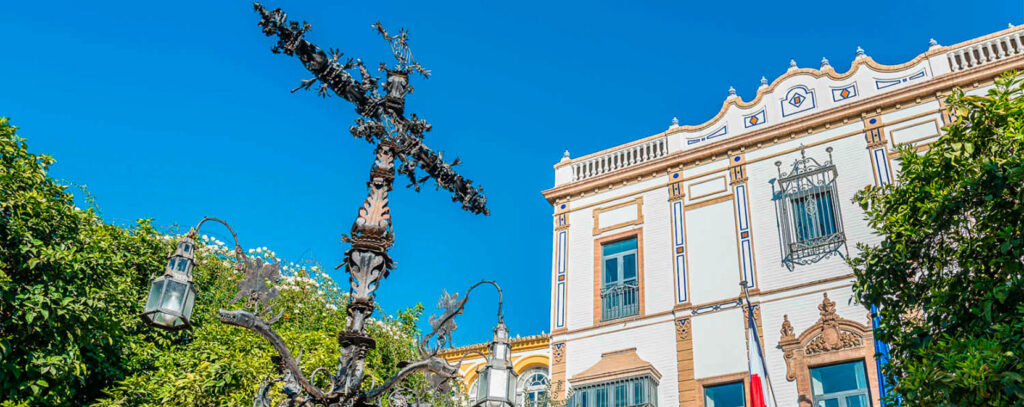
Santa Cruz is the most historic and architecturally rich neighbourhood in Seville. Its winding alleys, tiled patios, and layered past reflect centuries of Islamic, Jewish, and Christian influence—all concentrated in one walkable, atmospheric district.
Islamic Foundations
Santa Cruz’s story begins under Islamic rule, when Seville was one of Al-Andalus’s most important cities. From 711 to 1248, the city thrived as a cultural and intellectual centre of the Moorish world. The area that is now Santa Cruz sat just east of the city’s Great Mosque, and many of its narrow alleys and courtyard homes follow the original Islamic urban design. The nearby Alcázar of Seville, begun in the 10th century and expanded by the Almohads in the 12th, remains the most important architectural legacy of this era. Its palaces, water channels, and Mudéjar detail are directly linked to Islamic aesthetic principles. The Giralda, originally the mosque’s minaret, was also built in this period before being converted into a bell tower after the Christian conquest. While much of the old Islamic quarter has been layered over by later developments, its foundations are still visible in the street layout and the enduring use of internal courtyards and water features.
Jewish History and Legacy
After the Christian conquest of Seville in 1248 by King Ferdinand III, the city’s Jewish population was moved into this area, now officially designated the Judería (Jewish quarter). This was the largest and most active Jewish community in medieval Andalusia, with synagogues, schools, and homes concentrated within the walls of Santa Cruz. Although the 1391 pogroms devastated the community—leading to massacres, forced conversions, and exile—some traces of Jewish life remain. The Church of Santa María la Blanca was originally built as a synagogue in the 13th century and later converted into a church, though some elements of the original structure are preserved. The layout of the neighbourhood itself—tight alleys like Callejón del Agua and hidden squares—is a remnant of the medieval Jewish urban design. Today, there are plaques and subtle markers commemorating the Jewish history of the area, though much has been lost or repurposed. Jewish visitors may also appreciate the quiet symbolism of spaces like Plaza de Santa Cruz, built atop a former Jewish cemetery.
Christian Transformation
Following the Reconquista, Santa Cruz gradually became a prestigious Christian neighbourhood, especially in the 16th and 17th centuries. The Seville Cathedral, built on the site of the former mosque between 1401 and 1506, became a defining symbol of Christian Seville—now one of the largest Gothic churches in the world. The Hospital de los Venerables, founded in the 17th century, remains a Baroque masterpiece and one of the area’s key attractions. Throughout this period, many Moorish and Jewish buildings were either demolished or reworked into Christian architecture, leading to the stylistic blend of Gothic, Renaissance, and Mudéjar that characterises the area today. The Christian nobility continued to favour Santa Cruz for its central location and refined atmosphere, leaving behind ornate churches and tiled mansions.
Modern-Day Santa Cruz
Today, Santa Cruz is one of Seville’s most visited neighbourhoods, and for good reason. Its maze-like alleys, hidden courtyards, and flower-filled balconies make it an endlessly photogenic area to wander. It’s also a hub for cultural tourism, with major sites like the Alcázar, Cathedral, and several museums located within a few minutes’ walk of each other. For those looking to relax, spots like Plaza de Doña Elvira, Jardines de Murillo, and quiet terraces near Calle Mateos Gago offer a peaceful break from sightseeing. Romantic at night and family-friendly by day, the area balances its deep historical weight with a light, walkable charm. It’s a great base for visitors and a place where Seville’s layered history is felt on every corner.
There’s much more to discover in Seville! Check out our Guide to Seville for a closer look at the city’s culture, heritage, and unmissable experiences.
For recommended places to stay in Seville, check out our ‘Guide to the Best Hotels in Seville‘ Guide!